Sunday, March 11, 2007

Back Bay's Bonus Twilight Hour ...


This was a sweet city evening with unnaturally long 6:30 shadows and 50 heartwarming degrees. Result: Spring fever with a nice little twist of strangeness.

I'd just heard pianist Eric Sedgwick play at First Church Boston (formerly First and Second Church). Eric is an astonishingly gifted graduate student at the Manhattan School of Music. I was so grateful that he'd done Leon Kirchner's first piano sonata, written in 1948 when the composer was only 28. Sedgwick grabbed the controls and unleashed the thing, finding all of its luminous crevices and dangerous corners. He also found its lyricism and quick wit. I love this music. At 88, Kirchner is still inspired. Sedgwick got it right.

When I stepped out, it was Twilight Savings Time, and the surprise of the softness of the air, and the weird length of my shadow on these undulating, heel-devouring brick sidewalks gave me spring fever. It started me on a dizzying walk that vacillated deliciously between Memory Lane and Avenue of the Future ...
Good Old Boston.
I'm still here.


Sunday, March 04, 2007

The astonishing J. Haguttohamenazy


And as for the pianist Joyce Hatto, I'm looking forward to doing what I've not yet been able to do -- listen to an honest recording, in which she/they are uncompromised. And I'll listen with real compassion.
Jeremy Denk gets the award for the strangest post on Hatto. And don't miss Matthew Guerrieri's eloquence either.

(P.S. The kindergartner in me used Vladimir Ashkenazy's right shoulder and ear; Hatto's hair and nose; a slice of the face of Horacio Gutiérez; and the hands of Marc-André Hamelin, all of whom had their work, in part or in complete performances, used by W.H. Barrington-Coupe in his wife's recordings.)

(P.P.S. Here's a report by the excellent Alex Gallafent of PRI's "The World" which includes interview clips with retired Boston Globe critic Richard Dyer, and a couple of smaller points made by yours truly.)

Monday, February 12, 2007

Talking to Osvaldo


An interview with Osvaldo Golijov, who's just claimed a couple of Grammy awards for his opera Ainadamar.

Sunday, January 14, 2007

Sweet, Synchronized Dream


I happened upon the enchantment below after reading Jessica Duchen's article in the Independent about the joys and hazards of YouTube.
I am so fond of Debussy's warm observance of the lives of children. I love the pieces that are musical mirrors of children's secret and open-hearted worlds. He captures essence of that sweet quickness that moves them from universe to universe when they are deeply absorbed ... that quick and determined little dance they do that melts the heart with an admiring kind of love.

This little film captures the dance, too. It includes three of the pieces from the Children's Corner Suite, dedicated to Debussy's little daughter Claude-Emma (Chouchou). The dance is captured through a layering of great minds:
Emile Vuillermoz, music critic, biographer of Debussy and friend and student of Ravel. He wrote Musiques d' Aujourd'hui (Music of Today, 1923), Histoire de la Musique (History of Music: 1949), Claude Debussy (1957), and Gabriel Fauré (1960); filmmaker Marcel L'Herbier; pianist Alfred Cortot and Debussy. It's a recipe for intelligent magic.

Here it is.

Vuillermoz, by the way, was the kind of critic who could write this way: (here he's describing the opening of Debussy's Prelude to the Afternoon of a Faun): "The alternation of binary and ternary divisions of the eighth notes, the sly feints made by the three pauses, soften the phrase so much, render it so fluid, that it escapes all arithmetical rigors. It floats between heaven and earth like a Gregorian chant; it glides over signposts marking traditional divisions; it slips so furtively between various keys that it frees itself effortlessly from their grasp, and one must await the first appearance of a harmonic underpinning before the melody takes graceful leave of this causal atonality." (Emile Vuillermoz 1957)

Debussy with his daughter Claude-Emma (Chouchou).

Friday, January 12, 2007

Discs, nerves and rubbers ...

While I'm stuck at home, ever-so-patiently waiting for a disc in my neck to fall out of love with a nerve in my arm (they should never have met), I see I've arrived at the time of night when I am simultaneously missing two great concerts. One of them is a little far away ... Marc-André Hamelin in Philly playing Villa-Lobos's ecstatic nerve-pinch, the inexplicable portrait of Arthur Rubinstein that Villa-Lobos called "Rudepoêma". Hamelin's performance leaves you gasping ...


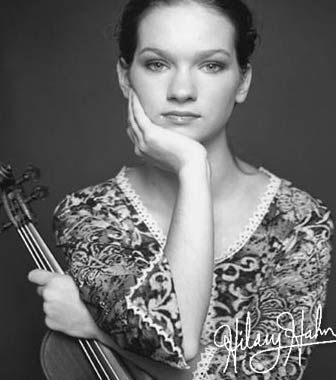
The other concert is maddeningly close. Hilary Hahn, 15 minutes away at New England Conservatory's gorgeous Jordan Hall. I noticed on the Bank of America Celebrity Series blog (one of my faves) that she has a blog of her own. Her "itty-bitty news" items brought me a smile. This one, for example:

"Maestro Has a Request"

Some moments are the stuff of comedy routines. This is a scene from a recent rehearsal, exactly as it happened. The conductor was European, the orchestra of British descent.

"Does anyone have a rubber?" the maestro asked the orchestra, pencil in hand.

A titter passed among the musicians. Realizing his double-entendre, the conductor turned crimson, ruffling his hair in an embarrassed gesture.

The principal violist located a large white eraser and handed it over. The conductor rubbed out an old pencil marking, then returned the eraser. A quip was made about sharing a rubber, getting it back used.

A minute later, the eraser was borrowed again, and again returned.

The next time an eraser was needed, the principal violist gave the conductor a small, flat, white packet with serrated edges and a distinct shape inside. A surprised chuckle escaped the orchestra. The maestro shook his head, laughed, and held it up for all to see. He hesitated – and then, in one decisive motion, pocketed the package.

The joke was complete. Rehearsal continued as usual.


Also on Hilary's site
a sweet
note about the loss of
this little friend:


Well, here at home I'll quietly applaud all of the heroic, touring musicians who brighten our lives, while they live theirs, so unimaginably full of stresses and obstacles. And, very often, loneliness. Here's hoping for lots of gasping tonight, and riotous applause. And lots and lots of encores.

Thursday, January 11, 2007

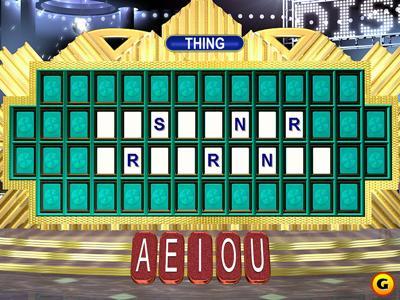
I'd like to buy a vowel, please ...


The principal carrier of [Edwin Fischer's] expressiveness was his marvellously full, floating tone, which retained its roundness even at climactic, explosive moments, and remained singing and sustained in the most unbelievable pianissimo. (In conversation, Fischer once compared piano tone to the sound of the vowels. He told me that in present-day musical practice the a and o are neglected in favour of the e and i. The glaring and shrill triumphs over the lofty and sonorous, technique over the sense of wonder. Are not ah! and oh! the sounds of wonder?) By bringing the middle parts to life, Fischer gave his chord-playing an inward radiance, and his cantabile fulfilled Beethoven's wish: 'From the heart -- may it go to the heart.'

From Musical Thoughts and Afterthoughts, by Alfred Brendel, Published by Noonday Press

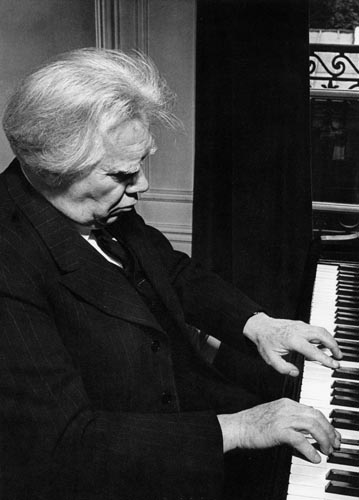
Here's what the ah! in Fischer's Bah!ch sounds like ...

Tuesday, December 26, 2006

Seeing Paris

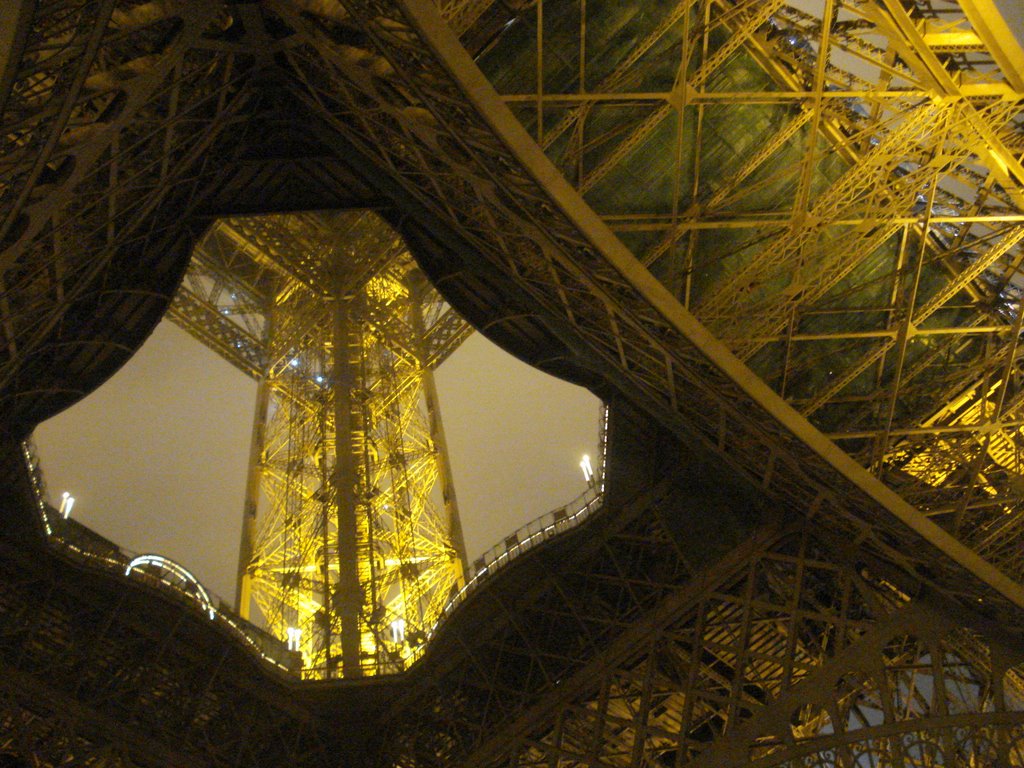
I'm just back from another overwhelming visit to Paris, where my daughter is spending her junior year. Paris startled me, seduced me, soothed me, reduced me to tears. I saw it deepening in Alexandra's eyes. In the little time I had, I could see it bringing her into her newest state of being. She inhabits the place, and it inhabits her.

With my little camera I tried to find a new angle on that wonderful old feat of astonishing organization:


And I tried to capture Alexandra:


We found, thanks to a precious friend, an astonishing feat of disorganization called Un Regard Moderne, a shadowy little bookstore that pulls its delighted victims into an old Paris wall and swallows them completely.

Monday, October 23, 2006

Unbelievably, it's taken until now to get the juicy Boston arts blog of Geoff Edgers on the blog roll. Sorry for the delay.

Saturday, October 14, 2006

Fallen


Found this one lying quietly on Commonwealth Avenue.

Good Vibrations


If Debussy's insistence that you get your piano to sound like it has no hammers is a little bit too taxing an illusion to maintain, maybe it's easier to consider the sweet, flexible nature of those hammers, and the profoundly magical result that comes from their vibrations. R. Wormleighton, Ph.D. writes about tone in his paper "The Fundamentals of Piano-Playing", attempting to disprove the 1934 conclusions of Hart, Fuller (no relation) and Lusby, who claimed that the pianist can control only hammer velocity -- that's it, nothing else -- and that control of tone is an illusion. Their big mistake, he says, lies in the assumption of the rigidity of the hammer.
Wormleighton describes the perceptual importance of the sound and nature of the attack (the "prompt sound"):

A string prefers to vibrate at its own natural frequencies, or harmonics, which are determined by the length, weight and tension of the string. When vibrating at these frequencies, the energy is dissipated very slowly and the sound lasts a long time. If other frequencies are imposed on the string, however, the energy in those frequencies disappears quickly as soon as the driving force is removed.
(my italics)

When a piano key is depressed, the energy is transmitted to hammer-and-arm and then, when the string is struck, from hammer to string. The flaw in [Hart, Fuller and Lusby's] simplistic model is the assumption that all the energy in the hammer is the kinetic energy of its forward motion. This would only be true if hammer-and-arm were a rigid body. But because it is quite flexible, depression of the key not only throws the hammer forward, but causes it to vibrate. And the vibrations are at the natural frequencies of hammer-and-arm, which differ from those of the string. When the hammer strikes the string, two things happen: the kinetic energy of the forward movement is translated into the natural frequencies of the string; the vibrating hammer imposes its own extraneous frequencies on the string for the 6 or 7 milliseconds of contact. Hence the prompt sound consists of both natural and imposed frequencies: as soon as contact is broken, the latter quickly disappear and only the former remain. The prompt sound, which lasts for the first one or two hundredths of a second, contains the harsh dissonant frequencies; the after sound consists only of the natural string frequencies.

A sound is pleasing and musical when it is dominated by the lower harmonics of the note and discordant frequencies are weak. Thus the pianist wants to maximize the energy in the natural frequencies, i.e. the kinetic energy of the forward motion, and minimize the vibrational energy that produces the discordant frequencies in the prompt sound. The relative strengths of the natural frequencies are determined by the structure of the piano. But the division of energy between forward motion and hammer vibration can be controlled by the pianist. A key that is hit from above will jar hammer-and-arm into strong vibrations but, if the key is accelerated smoothly, vibrations are minimal, and so are the discordant frequencies in the prompt sound. The key to tone control thus lies in the way the key is depressed and the hammer is accelerated.

The above theory explains the effect of the mis-named soft pedal, which primarily affects tone rather than loudness. Except in the bottom octave, each note has two or three strings. When the action is shifted by the soft pedal, one of the strings is not contacted by the hammer. The hammer imposes its own frequencies on one or two, but not all of the strings and less prompt sound is produced. The unstruck string vibrates sympathetically only at its natural frequencies, reinforcing the after sound. Less prompt sound, more after sound, sweeter tone.

The theory provides a plausible explanation of how tone can be affected by the pianist, but has not been fully verified experimentally. No one, to my knowledge, has recorded the vibrations of the hammer.


Oh, but all the science is blinding, isn't it ... I'll have to assume that somewhere in that paper is talk about all the sympathetic singing and whispering ... all the distancing and shadowing ... all the magic that happens when you put the pedal down ... not to mention when you set the dampers to kissing and teasing the strings ....

Anyway, it's October in New England, and the kitchen window is overcome with blueness and sunlight. And the dry sweet air touches my face in such a way that I'm overcome, too. Autumn always prompts a strange thrill of melancholy.

Sunday, August 06, 2006

Thumbs, Well-Armed Men and Generous Friends

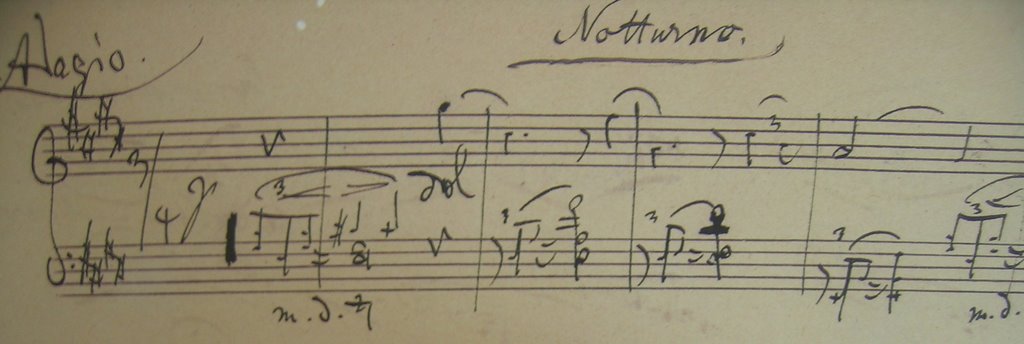
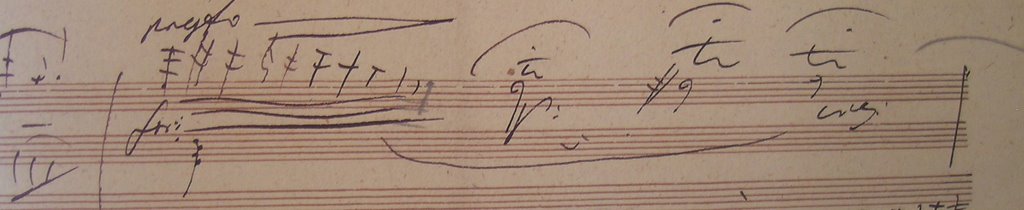
An immensely generous friend recently offered me some bound copies of manuscripts by Beethoven, Brahms and Chopin. I've been spending time with the ink spills (Beethoven Op. 101),


and the corrections (Chopin F-Major Ballade),


and the name changes (Brahms E-Major "Intermezzo" Op. 116 No. 4).


(Click on any of these photos for a bigger look.)

Beethoven sent a letter about his piano sonata Op. 101 to the Viennese publisher Sigmund Anton Steiner in 1816:

As regards a new sonata for pianoforte solo, all that need happen is for sixty well-armed men [i.e. gold ducats] to present themselves and it can be produced forthwith.

(Of course, it wasn't finished yet.)

I find real comfort in seeing the direct, inky result of Beethoven's thinking. In some ways it seems to offer proof of the brilliance and the absurdity of our system of musical notation.

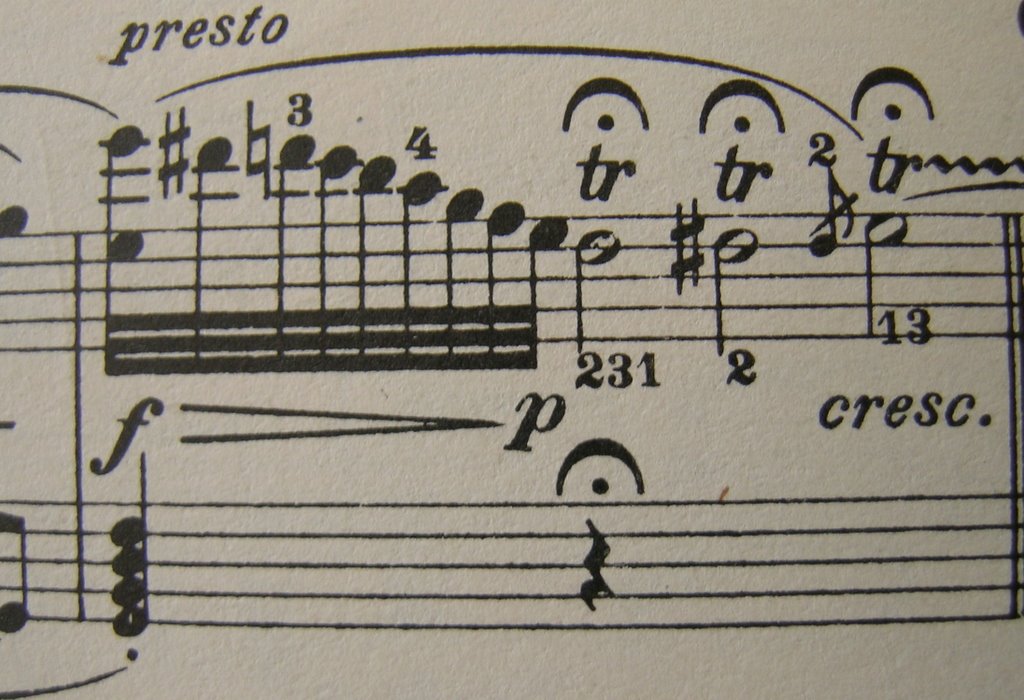
The trademark, timeless, out-of-body thrill that comes when Beethoven writes a series of hovering trills seems to have an appropriate look in his hand:


While a publication can seem to take the thrill and imprison it:


When Brahms finished his exquisite set of Fantasies, Op. 116, he sent a copyist's manuscript to his trusted friend Clara Schumann. The E-minor Intermezzo begins this way:


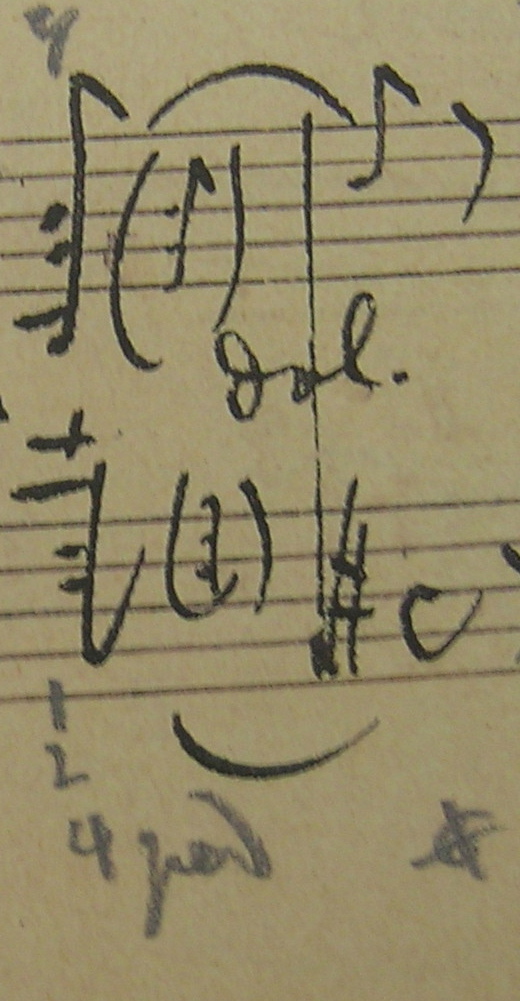
The opening upbeat forces the thumbs to interlock, the one crossing over the other.
Brahms wrote an optional, bracketed fingering in his manuscript that kept the player's thumbs from getting entangled:


Along with the manuscript, Brahms wrote to Clara:

In the little piece in E minor it is probably best if you always take the sixth eighth-note as indicated by the bracket on the upbeat.


Clara wrote back:

First of all, my thanks for the marvelously original piano pieces, with which I am now fully acquainted. But I would not wish to hear the E minor piece with the small notes as the interlocking of the hands has a charm all its own, and indeed produces a completely different sound!


I'm sure Brahms must have caught the wisdom in his friend's words.

Where would any of us be without our generous friends?

Monday, July 31, 2006

Pliable's Path

Pliable has developed such elegant blogging chops that what he delivers is always a rich and sensory experience. A recent post takes the fast lane on a bizarre route that begins with Condolleeza Rice scowling at Brahms, and moves through Hitler, Hanfstaengl and Poulenc ... and then finishes with the voice of Paul Eluard himself, reading his poem "Liberté". Virtuosic blogging. Always an essential read.

Saturday, July 22, 2006

More Recent Shivers ...


Best "God-I-love-young-musicians" shiver:
Yesterday, the Pacifica Quartet flooded WGBH's Studio One with their vibrant, highly charged playing. And as we talked, I had the quartet's eight exuberant eyes to wonder at ... all of them sparkling at me with an almost disarming sense of playful assuredness. Young players of this caliber always give me the most warm-hearted shivers, and leave me with a sense that the the great string quartets written long ago, and those still unwritten, are in really, really good hands.

The Pacifica played Mozart's "Dissonant" Quartet, and then the profoundly moving Shostakovich 8th. My favorite remark came in response to my asking this:
"It's the Mozart year ... we're all thinking so hard about him, it wouldn't surprise me if we somehow collectively made him reappear. Were he to walk in now and catch you rehearsing, what would you need to ask him?"

Simin Ginatra:
"I think I'd tell him not to waste his time on us ... just please go write some more music."

Watch WGBH's webcast page over the next couple of weeks for their live performance and interview.


Most recent Schubert shiver:
Many times I have broadcast the luminous and delicious recordings of the Duo Tal and Groethuysen. And I've always reveled in their golden sound and absolute oneness of mind and heart. But last week, the shivers came in little packages (little Schubert packages): Schubert's Deutscher with Two Trios and Two Ländler D.618,
Four Ländler D.814 and the strangely heartbreaking little March for Children in G major, D.928. Yaara Tal was born in Tel Aviv and Andreas Groethuysen in Munich. Combined, they are pure magic. They play on a Fazioli piano for reasons described at some length in the CD booklet.
What a nice present the complete boxed set of Schubert's four-hand piano music would make ...

Sunday, July 16, 2006

QWERTY


I fell strangely in love with typewriters when I was in high school. I even became quick enough that our teacher challenged me to a lunchtime duel. (She won.)

And now I find that Boston has its own typewriter orchestra.
Their QWERTY waltz goes like this.
Aren't you jealous of this town?

Saturday, July 15, 2006

Back


A blog, I can tell you, will whisper and scratch at you, should you neglect it for too many months ...

But a recent comment, the result of a cyber-stumble, has jostled me back to the sphere. Thanks to Paul for the note.

Jeremy Denk's recent posts (especially his funny encounters with frogs) make me think that he's lucky enough to have created a kind of living notebook where he can unburden his unceasingly inventive and associative mind. Nomadic pianists seem required to invent their secondary worlds of intrigue. And especially summer nomads in "FestivaLand" as he calls it, ("a performance, a reception, and an outgoing flight") where problems come up, and there's no time to debate or resolve them. He's now onto the subject which always seems to reject normal vocabulary -- the issue of "leaving a piece alone" ... letting it speak for itself .... Someone in FestivaLand had started in with the "just play it, don't interpret it" line of musical reasoning, prompting Jeremy to blog his heart out ("In my opinion, music doesn't want to be left alone.")

And this brings up the inevitable, somehow inane, discussion of where the player belongs in all the abstract layering of things: the composer's idea; the ideas in the player that the composer's idea inevitably must evoke; the arguable markings that plague the score; the trickery that can come with the visual display (or lack of it) that the player engages in; the ideas that are evoked in the listener's mind, which are born in part because of the player, who has played with his own ideas working urgently in his heart and mind (I hope) ... ideas that have been evoked by the composer's original idea, much of which is, in the end, up for deliciously abstract speculation.

There is a private realm within a musician. It's vast. It's not to be described. And it comes to life within the phrases (the ideas, the statements, the utterances, the music) of the composer. This realm is vital ... it must remain turned on. The door to it should never close. I suspect it's the same realm from which poetry is born.
Far beyond associative, it is a deep and fertile place in the imagination that connects us directly to music. Its power gives light and air and gravity and sensation and despair and shadow -- and all that's privately the most human of things -- to every phrase that a real musician really plays.

And great music invariably lights up this place in the heart/mind/imagination, so that the music becomes alive and develops a deeply satisfying sense of color, achingly human for the player, and mysteriously touching even for the listener who has never heard it before.

When the subject of "interpreting" and not mucking around with the score comes up ... when a listener makes conversation by implying that too many people "do too much" with the music, it brings all this up.

It's a hard conversation.
But play anything -- any phrase ... even just two consecutive notes ... with every marking intact, but without access to the poetic realm, and there is a dry and two-dimensional result that can feel downright offensive. Mostly, it's sad.

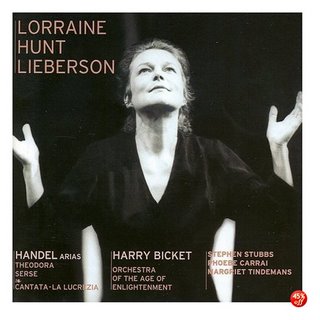
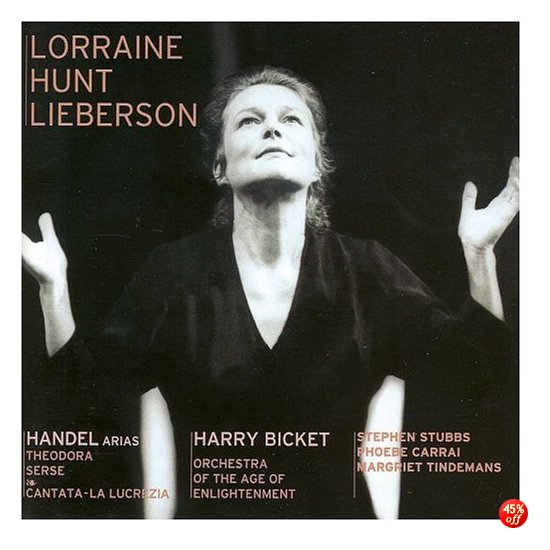
Today when I was teaching, I noticed that months ago I'd penciled in to the top of one of the pages of my student's Schubert sonata "Lorraine Hunt Lieberson -- Handel arias" ...

My heart skipped a beat. She was someone so completely connected to the poetic realm that not a single soul seemed to miss out.

I had wanted my student to be inspired by her. To find a way to be hugely communicative, even when the marking is pp.
Or better,
because the marking is pp.

Monday, April 17, 2006

Pulitzer in mano!


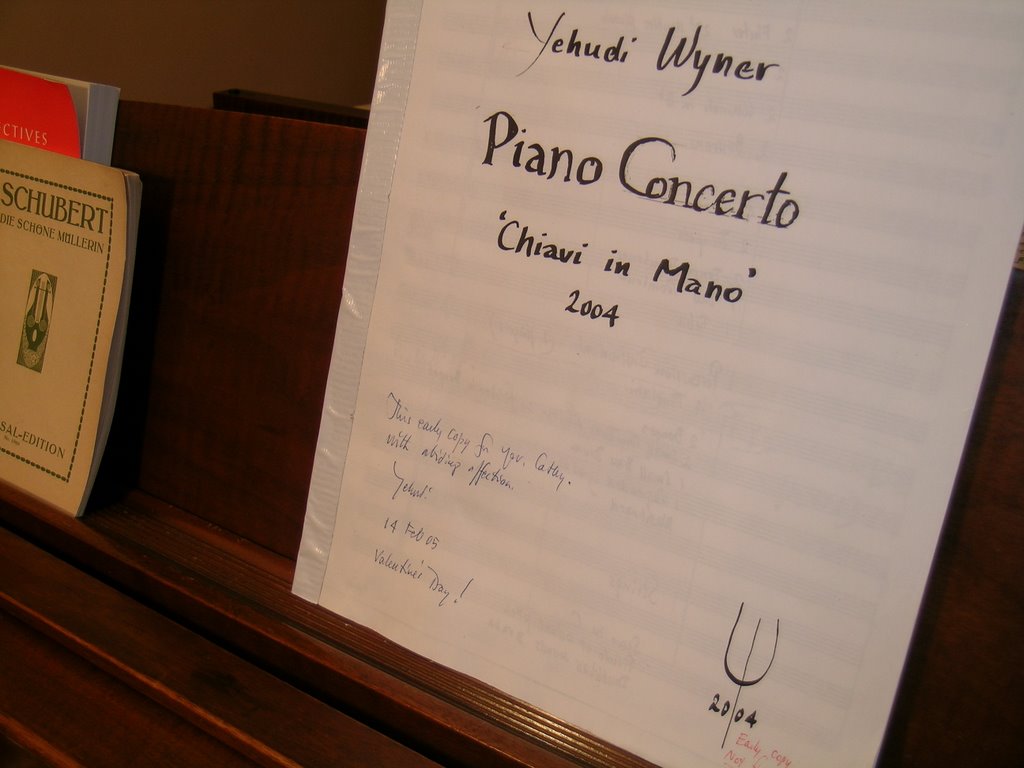
This early manuscript hasn't left my piano since it was given to me by its composer Yehudi Wyner in February 2005. It was just before pianist Robert Levin and the Boston Symphony Orchestra gave the premiere under conductor Robert Spano. I was so deeply touched, and I've lived with the score as an inspiring part of my daily landscape.

Just hours ago, it was announced that Yehudi will be awarded the 2006 Pulitzer Prize for this piece.


And I'm relishing this ecstatic feeling that the world is back to spinning as it should.

The concerto is delicious. It's charged. And it's propulsive and human .. witty, vital and warm. It glistens.

The composer's note from Schirmer:
The idea for a piano concerto for the Boston Symphony was instigated by Robert Levin, the great Mozart scholar and pianist. The idea was evidently embraced by BSO Artistic Administrator Tony Fogg and supported by Music Director James Levine.

Much of the concerto was composed during the summer of 2004 at the American Academy in Rome in a secluded studio hidden within the Academy walls. While much of the composing took place far from home, the concerto comes out as a particularly "American" piece, shot through with vernacular elements. As in many of my compositions, simple, familiar musical ideas are the starting point. A shape, a melodic fragment, a rhythm, a chord, a texture, or a sonority may ignite the appetite for exploration. How such simple insignificant things can be altered, elaborated, extended, and combined becomes the exciting challenge of composition. I also want the finished work to breathe in a natural way, to progress spontaneously, organically, moving toward a transformation of the musical substance in ways unimaginable to me when I began the journey. Transformation is the goal, with the intention of achieving an altered state of perception and exposure that I am otherwise unable to achieve.

"Chiavi in mano" - the title of the piano concerto - is the mantra used by automobile salesmen and realtors in Italy: Buy the house or the car and the keys are yours. But the more pertinent reason for the title is the fact that the piano writing is designed to fall "under the hand" and no matter how difficult it may be, it remains physically comfortable and devoid of stress. In other words: "Keys in hand."

--Yehudi Wyner, December 13, 2004


My infinite heartfelt and admiring thoughts go to this genuine and brilliant man.

There is an interview which I did with Yehudi and Robert about the concerto and much more here

Congratulations, Yehudi!
With much, much love.

Tuesday, April 04, 2006

Taming the lascivious sarabande ...


I've recently spent time visiting again with the G Major French Suite of Bach. Even after playing it in concert, the mysteries of its songful Sarabande continue to tickle me and draw me back, back, back to the piano. On certain days it is unearthly -- a perfect, weightless dream. On other days, its shadows and crevices become essential. It gets weighty and human, and I bend it, perhaps, where it shouldn't be bent ...
These different lights seem to change the music every day. It can feel different every time I touch it.
Ah, Bach anguish.
The other day I was lying on my living room floor (I'm not sure why) and there on a very low little bookshelf was Meredith Little and Natalie Jenne's book Dance and the Music of J.S.Bach.
Chapter 7 tracks the "tawdry" history of the Sarabande. From Spanish origins, it arrived in Italy as an exotic and tempestuous dance with fiery variations. Opponents wrote passionately against its lasciviousness.
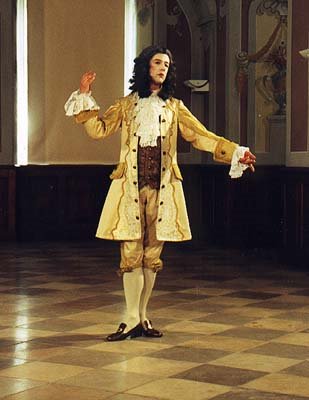
The French are said to have "tamed" the thing, giving it order and balance. But the two authors spend time considering the teasing passion behind all that balance by citing a recently discovered description written in the 1600's of a solo dancer seducing a crowd with his sarabande:

At first he danced with a totally charming grace, with a serious and circumspect air, with an equal and slow rhythm, and with such a noble, beautiful, free and easy carriage that he had all the majesty of a king, and inspired as much respect as he gave pleasure.

Sometimes he would glide imperceptibly, with no apparent movement of his feet and legs, and seemed to slide rather than step. Sometimes, with the most beautiful timing in the world, he would remain suspended, immobile, and half leaning to the side with one foot in the air; and then, compensating for the rhythmic unit that had gone by, with another more precipitous unit he would almost fly, so rapid was his motion.

Sometimes, for the pleasure of everyone present, he would turn to the right, and sometimes he would turn to the left; and when he reached the very middle of the empty floor, he would pirouette so quickly that the eye could not follow.

Now and then he would let a whole rhythmic unit go by, moving no more than a statue, and then, setting off like an arrow, he would be at the other end of the room before anyone had time to realize that he had departed.

But all this was nothing compared to what was observed when this gallant began to express the emotions of his soul through the motions of his body, and reveal them in his face, his eyes, his steps and all his actions.

Sometimes he would cast languid and passionate glances throughout a slow and languid rhythmic unit; and then, as though weary of being obliging, he would avert his eyes, as if he wished to hide his passion; and, with a more precipitous motion, would snatch away the gift he had tendered.

Now and then he would express anger and spite with an impetuous and turbulent rhythmic unit; and then, evoking a sweeter passion by more moderate motions, he would sigh, swoon, let his eyes wander languidly; and certain sinuous movements of the arms and body, nonchalant, disjointed and passionate, made him appear so admirable and so charming that throughout this enchanting dance he won as many hearts as he attracted spectators.

Sunday, February 19, 2006

"If you were to play me a tune ..."


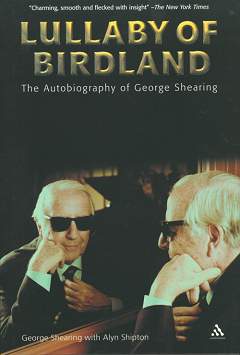
I've rediscovered on our WGBH website a conversation with pianist George Shearing that has me all stirred up. This is the kind of casual and revelatory talking, constantly punctuated by spontaneous playing, that makes me love the radio. I hope you'll take some time to go here.
Then poke around for more astonishments ... Golijov, Machover, Piston, Copland -- and don't miss Lawrence Rosenwald reading some of Emerson's most transcendentally powerful lines and then handing off to members of the Triple Helix Piano Trio, who find similar transcendence in Charles Ives.
Delicious.