Wednesday, March 16, 2005

Humor envy ...


I develop an occasional paralysis... a blogging block ... and large chunks of time go by without posting.
This is the opposite condition of Lance Mannion, who can blind you with his sheer blogging virtuosity.

He's quick ... funny ... and boy, he's just got LOTS of time to post.
I've got Lance fixed in a kind of Mozart category. Mozart's hyper-achieving defied the normal passage of time. There must have been a "Mozart minute" which adhered to none of the rules of earthly science.

Or maybe Mr. Mannion's a little like Art Tatum. I learned recently from a brilliant
scientist/pianist that psychoacousticians (I also learned that there are psychoacousticians) have a unit of speed called a Tatum, indicative (I hope I've got this right) of the maximum amount of audio information that the human ear can take in in one second. It's named for Art Tatum, who could play more notes in one second than any other human.
And he was blind ...
Which probably, somehow, helped.
They could have called it a Paganini ...
but Tatum's hipper.

Here's where to go to hear an interview I very much enjoyed doing with scientist/pianist Michael Hawley. He describes the life and magic of Art Tatum, and plays transcriptions of Tatum's recordings with astonishing prowess. He also plays Bach/Busoni, Chopin, and Guastavino. click here

And here's a little afternoon toast to Lance -- whoever you are.

Saturday, February 26, 2005

Landing on the Moon with a 12-year-old ...


I was recently invited to the press opening of Robert Lepage's "The Far Side of the Moon" at the American Repertory Theater.
Desperate as I am for magic, and desperate as I also am to help my children to appreciate a desperation for magic (or something close to that), I took my youngest one along ... not knowing the degree to which the thing unfolds with a kind of elegant, exquisite desperation of its own.
Desperately innovative.
Desperately poignant.
Desperately symbolic.
And desperately beyond her.

Theater can do such magic. I'm so sorry I'm so rarely in its grip.
This is a virtuosic one-man show with Yves Jacques playing two brothers, both desperate, really ... one a gay weatherman in love with money, the other a kind of sweet, depressed misfit obsessed since childhood with the space race. And he is constantly, constantly failing at everything. He's really not able to connect with other humans, and his only success is a sad home-made video of his own tiny, luckless world. The video wins a contest and is chosen to be sent into space.
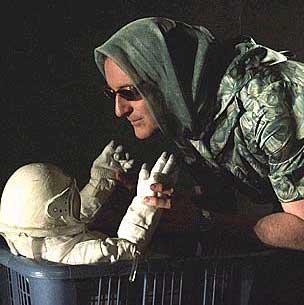
He deeply loved his mother, who ages and dies (it's discovered later that she killed herself), and in one scene he becomes her ... with green pumps and a dress ... dancing slowly and lovingly with a small, alarmingly expressive three-foot-tall astronaut-doll.

Effects through projection and trompe l'oeil took my breath away. I remember feeling physically excited by their elegance and cleverness.

The final scene used the enormous mirror that had tilted and twisted to astonishing effect throughout the play. In the end it took on an angle which allowed the actor to writhe around the floor of the set and perfectly, perfectly! create another reality in the mirror. There he was -- floating, weightless, without gravity ... slow somersaults and exquisite tumbles ... and he was perfect. A contented astronaut finally in his element.
The first movement of the "Moonlight Sonata" accompanied his floating, and it worked amazingly well.

In fact, I imagine I'll never hear those triplets in the same way again.
All of it was a gorgeous thing. I was feeling that I understood every decision ... every symbol ... every delicious metaphor for life and its absurdity. Every bit of humor was marvelous.
I wanted to kiss the actor.
At the end the theater was up on its feet, and I asked my 12-year-old if
she liked it ...

And she said she really didn't like it at all.

Of course she didn't. How could she?
She found it strange.
But it had an effect ...
The other night she told me that she's writing a short story at school about a daughter and father who discover, when rummaging through the basement, that the mother had killed herself.
(I can imagine what her teachers are thinking.)

And so up again sprang a recurrent little distance-of-mothers theme that just keeps knocking inside me. Being the reader for Earl Kim's piece "Dear Linda" the other day didn't help to make it go away, either.
Anne Sexton's love letter to her daughter is pretty damn hard to pull off: "I'm in the middle of a flight to Saint Louis ...." "I was reading a New Yorker article that made me think of my mother" ... "I love you 40-year-old Linda" ... "I wrote unhappy, but I lived to the hilt ... you live to the hilt, too Linda ...." etc. etc.
All with hauntingly sad piano sounds and flute sounds ... and cello sounds ... percussion sounds ...
It's one thing to rehearse it in a basement practice room in Harvard Square. But put the damn thing in a large, darkened concert hall, add the strange intimacy of a microphone that gives you the odd and sexy power to make huge your most whispered voice so that it reaches the exit signs ...
Well, then the thing, even when it is at its most musically cliché, becomes a thing of power ...
When you are asked to deliver: "I too was 40 once, and with a dead mother who I needed still" ...
and then think of your own mother (dead when you were 40, of course) ...
Then it gets a little surreal.
At the end: ("x, o, x, o, x, o x, o .... Mom.") the pianist and percussionist were so understated, and my x's and o's became so small, and so big ...
The audience was so very, very quiet, that the decay of the last sounds (after "Mom") went on interminably, and my eyes grabbed onto a distant corner of the room and couldn't blink, or see. Everyone's breathing seemed to have stopped. It was such a very big relief to lower my hands in a slow signal that the thing had ended.
Thank God.

Friday, February 25, 2005

Suburban Doughnuts

Found the poem below scribbled in a badly-kept, well-wrinkled little notebook ... written in honor of suburbia's inspired gathering places (Dunkin' Donuts). I found in that same notebook the autograph, with an Italian phrase I cannot read, of Carlo Bergonzi ... must have grabbed the sad little wrinkly pad while on a musical tour of Tuscany, drinking too much wine in an attempt to prolong the dream.

I also found verses in praise of a train -- one which muscled its sleek way past all types of elegant graffiti, and husks of inexplicably burnt cars, and manicured lawns ...
a train which hustled me straight to the miraculous playing of the inspired keyboard navigator
Marc-André Hamelin ... who arrived at the piano, reached forward, and generously melted away the walls of the Miller Theater -- in order to let in the exquisite light of Albeniz's Ibéria.


Click here for an interview/performance with Marc-André Hamelin.

I also found notes scribbled during a financial aid information session at a potential college for my oldest girl.

All badly scrawled, and separated by many, many blank pages ...

I don't keep notebooks well.

_________________________

This is where fluorescent dreamers
gulp their milky
caffeine --
Chew at their
sourceless bread --
And pretend that the walls
offer comfort ...

Tricky-eyed.
Looking downward.

And just outside --
Beside the glass --
The sky is ravishing!
Blushing ...
Bright ...
A sweet, fiery sun
between the sad single trees
And the unending turnpike ...

Here ...
Cold clumsy cars made of
dirt
Keep dancing and
blinking --
Women in tired heels
Look downward --
Tricky-eyed.

From the ceiling,
At a careful slant,
A television
screams
To keep our pupils
shrunken ...

The ravishing sky
deepens and
closes.
No wide eyes
to sparkle at ...
No poets to gleam for.

So the sunset dies.

And the fluorescent ghosts
pay no attention
to the
dark.

Wednesday, February 23, 2005

Visions ... and hearing loss ...

Sex sells.

Musicians are offered up as sensual visions.
Chosen ones with secret breezes that blow their locks just so.
Bearers of the torch of beauty and light.
Tantalizing in their perfect understanding of shadows and curves, with eyes wide (or shut) to signal their thrilling arrogance.

They are pictures.

I wonder. When they are bought ... if that moment of purchase is just a lusty
grab ...
Then what happens after that?
Does the music pour forth and a divine path become suddenly cleared to take the trip from lusting to listening?
And then from listening to loving?
And then from loving to ...
transcending?

Are these glossy visions meant to symbolize sheer
commanding power?

Like elegant strippers?
Specially made bodies fueled by the irresistable essence of
art?

Am I being reminded that it is the musicians who control those secret breezes which tickle my most private of places?
That from the ideal face flows the perfect phrase ...
From the shapeliest shoulder, the most truthful vibrato ...
From the highest-heeled ankles, the most exquisite pedalling ...
From the roundest bosom surely must come the most insightful, devastating, inspired unleashing of the layers of life that
throb and throb
in the greatest of fugues.


What nasty business, the business of selling

Friday, January 07, 2005

Stuffing my pockets at the bookstore ...

Last night's January twilight was glazed over with ice.

At the bookstore, I just couldn't spend that $35.00 on every last word packaged up so nicely into a new and attractive book
by Mr. Rosen .


So I spent $3.00 on a latte and strapped myself into these damn reading glasses (suddenly they're necessary) and began
stuffing his dry words into whatever pockets I could find in my over-burdened
memory.

Now on this brittle January morning I've checked my pockets and found that they must have holes.
I must have littered the parking lot with those well-chosen Charles-Rosen-words.

Maybe there are some in the car.

Some I still had. I found 1814-1819
and nephew
and suffering.
Opus 90 is caught up in that ugly time of deafness and mad desire to take ownership of the nephew.

Disintegration

It's the best of the words. It's always there in Beethoven. Imagine laying such careful plans to disintegrate. Imagine writing such beautiful undoings of beauty (that's not Mr. Rosen. He's better than that. And certainly more careful.)

I scrounged around and found that I still had Mr. Rosen's small and honest confession in one of my pockets. He admits that he's just not clear as to whether the end of the opus 90, having slowed, ought to gear up and move past its original tempo in that final cascade, and then retrieve the tempo in the last two bars ... or simply accelerate just enough to be back by the end.

It is a marvelous uncertainty set down boldly in a stern little font.
I found that reassuring.

And, as always, I again found my own confession. It kicks around in various costumes in virtually every pocket I own.
A nagging little ghost that scratches at the heart, claiming I've missed some elemental piece of knowledge.
Some essential wisdom which will prevent me from playing the music as they say it should be played ....

I just keep digging to see who they might be.

Wednesday, January 05, 2005

Small silver phones pressed desperately against the ear ...

Think of the depth with which we search the syllables, and each of their letters, and the nature of the breaths that surround them.
Think of the deep diving we do into the nuances of the vital voices that reach us by cell phone.

In a parking lot, perhaps, a call from someone deeply loved, whose voice comes but occasionally. A miraculous human.
I hear every inhalation ... each curl of the lip that darkens or brightens a vowel. (Might that be sadness? Could that slight sigh between words -- the one that teases my senses -- could that be some small resignation? a little motive that will develop later into difficult news? Is there a new distance? I clutch subtle accent, the audible smirk. Mundane words are given slightly new pitches and never-before-taken tempos. What are the secrets that motivate these punctuations?)

These, I thought, once I'd snapped the small silver phone shut ...
These are the questions I ask when practicing Chopin ...
When hearing a Schubert song ...
And while weeping through the ebb and flow of Schumann's Fantasy ...

How carefully we listen to our deeply loved voices on these small silver phones ...
What insightful listeners we are.

If only music could receive such attention.

Monday, January 03, 2005

The window and the Sarabande ...


It's changed.
It had been a darker affair. A single rectangle with a weakening sill and peeling paint. Brittle blinds with broken ropes.
(It seemed just as well ... only a cruel suburban crossroad to see. A house or two and a flagpole with its proudly clanging chain.)
There was, though, something right about
it.
Its dimensions I think.
Maybe its darkness.
Its angle on the shrubbery below?
It did ignite a memory of me-as-child and my window back then, with its same proximity to the piano.

It's changed now.
Someone new has bought the house, and I keep renting the walls for the sake of the ceilings. And suddenly, here it is! A dramatic bay window. And there, too, is the sky!

Old men now walk at length. I can learn their gaits. I once followed the shuffle of an ancient man for the entire first page of the G Major French Suite ...
Now children in this sun-soaked frame have complete choreographies to unleash.
Bicycles float past ... I have light on my face and my hands.
I can see the seasons.
There is a tree, and I'm learning its branches.
Chickadees halt and stare in at my anguishing.

And I wonder.
Does this change the practicing?
Deeply in love with the random dances that waltz into this dramatic frame, I wonder ...
Does this change the practicing?
For me, who never imagines changing the space myself,
I admire the thinkers who envision these big panes of glass.
I wouldn't have thought of this.
I wouldn't have guessed it would cause this warmth.

But whether the French Suite is better ...
Perhaps.
Because this bigger view keeps urging me to consider these unexpected dances, and allows me just enough time to absorb them.
The old man's arrival in the window frame ...
Strangely slow. Meticulous.
A purposeful trip across the glass. An elderly propulsion.
Never a change in tempo, but constantly new in his nearness to trees
and puddles of darkness and sunlight.
An occasional turn of the head.

Cruel suburban shuffle.
It's a lesson for a Sarabande.