Wednesday, August 09, 2006


Sunday, August 06, 2006
Thumbs, Well-Armed Men and Generous Friends
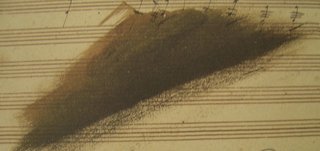
An immensely generous friend recently offered me some bound copies of manuscripts by Beethoven, Brahms and Chopin. I've been spending time with the ink spills (Beethoven Op. 101),
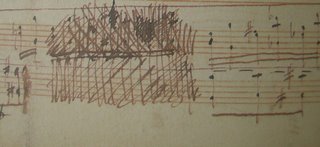
and the corrections (Chopin F-Major Ballade),
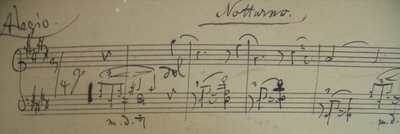
and the name changes (Brahms E-Major "Intermezzo" Op. 116 No. 4).
(Click on any of these photos for a bigger look.)
Beethoven sent a letter about his piano sonata Op. 101 to the Viennese publisher Sigmund Anton Steiner in 1816:
(Of course, it wasn't finished yet.)
I find real comfort in seeing the direct, inky result of Beethoven's thinking. In some ways it seems to offer proof of the brilliance and the absurdity of our system of musical notation.
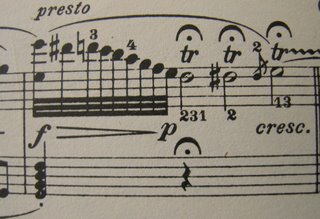
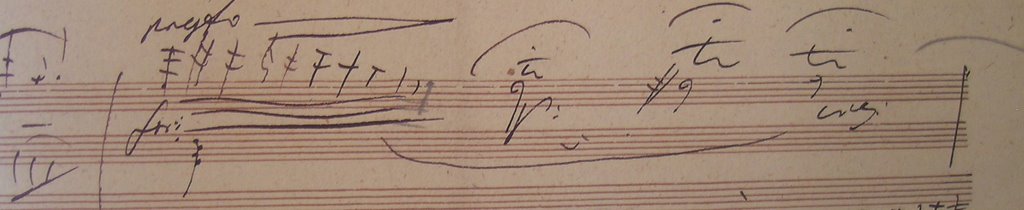
The trademark, timeless, out-of-body thrill that comes when Beethoven writes a series of hovering trills seems to have an appropriate look in his hand:
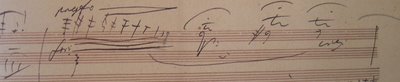
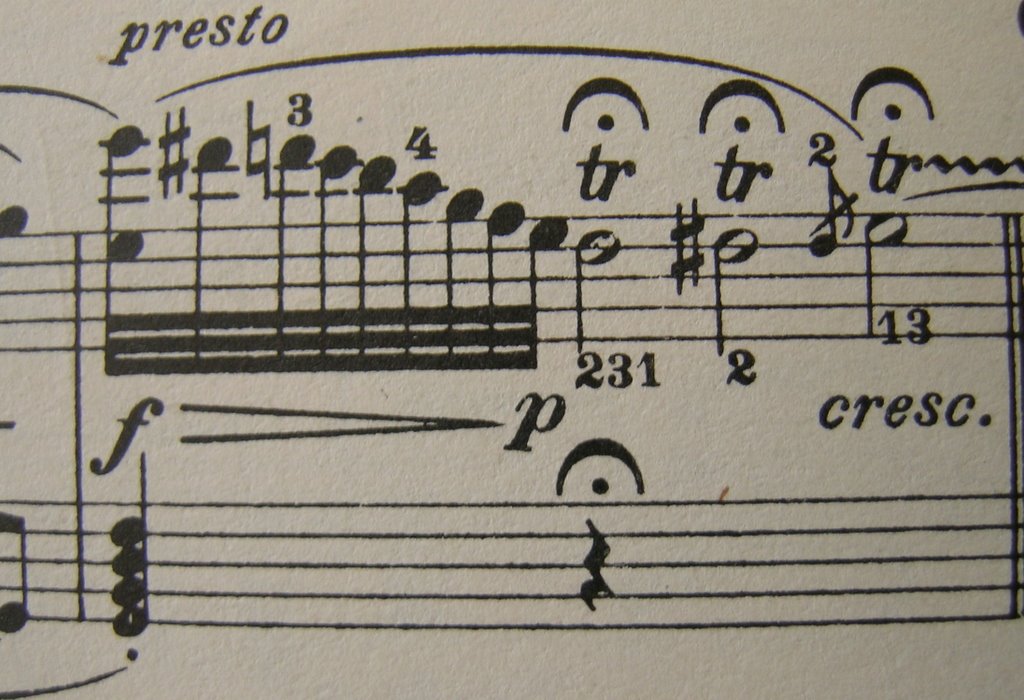
While a publication can seem to take the thrill and imprison it:
When Brahms finished his exquisite set of Fantasies, Op. 116, he sent a copyist's manuscript to his trusted friend Clara Schumann. The E-minor Intermezzo begins this way:
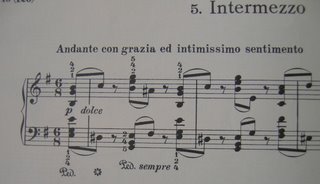
The opening upbeat forces the thumbs to interlock, the one crossing over the other.
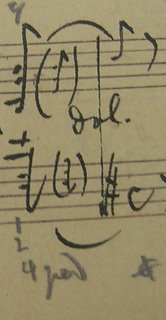
Brahms wrote an optional, bracketed fingering in his manuscript that kept the player's thumbs from getting entangled:
Along with the manuscript, Brahms wrote to Clara:
Clara wrote back:
I'm sure Brahms must have caught the wisdom in his friend's words.
Where would any of us be without our generous friends?

and the corrections (Chopin F-Major Ballade),

and the name changes (Brahms E-Major "Intermezzo" Op. 116 No. 4).
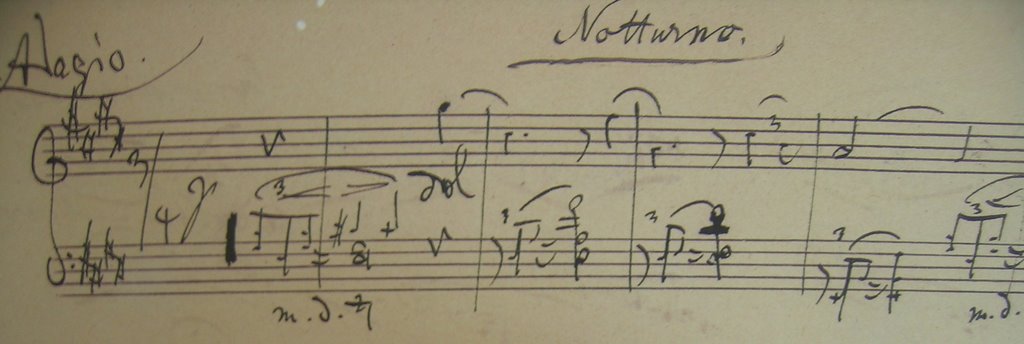
(Click on any of these photos for a bigger look.)
Beethoven sent a letter about his piano sonata Op. 101 to the Viennese publisher Sigmund Anton Steiner in 1816:
As regards a new sonata for pianoforte solo, all that need happen is for sixty well-armed men [i.e. gold ducats] to present themselves and it can be produced forthwith.
(Of course, it wasn't finished yet.)
I find real comfort in seeing the direct, inky result of Beethoven's thinking. In some ways it seems to offer proof of the brilliance and the absurdity of our system of musical notation.
The trademark, timeless, out-of-body thrill that comes when Beethoven writes a series of hovering trills seems to have an appropriate look in his hand:
While a publication can seem to take the thrill and imprison it:
When Brahms finished his exquisite set of Fantasies, Op. 116, he sent a copyist's manuscript to his trusted friend Clara Schumann. The E-minor Intermezzo begins this way:

The opening upbeat forces the thumbs to interlock, the one crossing over the other.
Brahms wrote an optional, bracketed fingering in his manuscript that kept the player's thumbs from getting entangled:
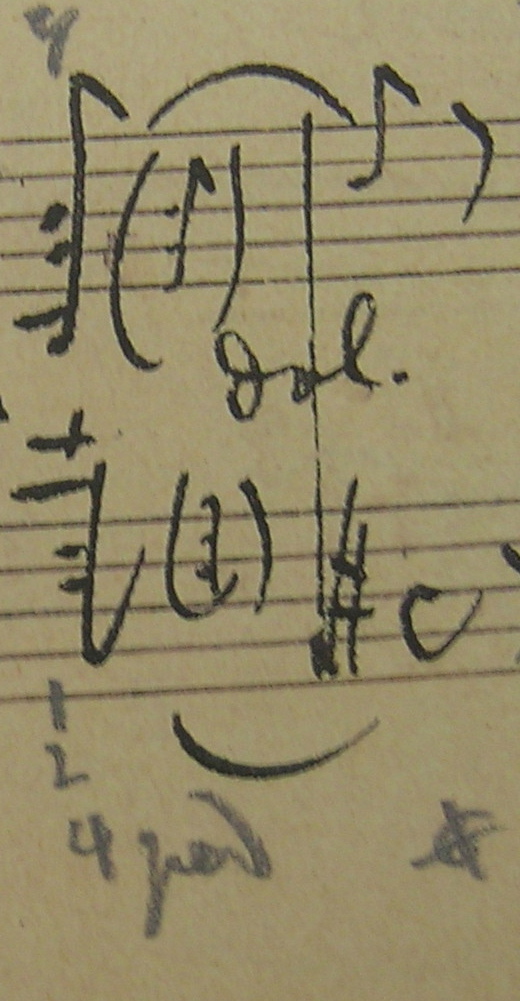
Along with the manuscript, Brahms wrote to Clara:
In the little piece in E minor it is probably best if you always take the sixth eighth-note as indicated by the bracket on the upbeat.
Clara wrote back:
First of all, my thanks for the marvelously original piano pieces, with which I am now fully acquainted. But I would not wish to hear the E minor piece with the small notes as the interlocking of the hands has a charm all its own, and indeed produces a completely different sound!
I'm sure Brahms must have caught the wisdom in his friend's words.
Where would any of us be without our generous friends?
Monday, July 31, 2006
Pliable's Path
Pliable has developed such elegant blogging chops that what he delivers is always a rich and sensory experience. A recent post takes the fast lane on a bizarre route that begins with Condolleeza Rice scowling at Brahms, and moves through Hitler, Hanfstaengl and Poulenc ... and then finishes with the voice of Paul Eluard himself, reading his poem "Liberté". Virtuosic blogging. Always an essential read.
Thursday, July 27, 2006


Saturday, July 22, 2006
More Recent Shivers ...

Best "God-I-love-young-musicians" shiver:
Yesterday, the Pacifica Quartet flooded WGBH's Studio One with their vibrant, highly charged playing. And as we talked, I had the quartet's eight exuberant eyes to wonder at ... all of them sparkling at me with an almost disarming sense of playful assuredness. Young players of this caliber always give me the most warm-hearted shivers, and leave me with a sense that the the great string quartets written long ago, and those still unwritten, are in really, really good hands.
The Pacifica played Mozart's "Dissonant" Quartet, and then the profoundly moving Shostakovich 8th. My favorite remark came in response to my asking this:
"It's the Mozart year ... we're all thinking so hard about him, it wouldn't surprise me if we somehow collectively made him reappear. Were he to walk in now and catch you rehearsing, what would you need to ask him?"
Simin Ginatra:
"I think I'd tell him not to waste his time on us ... just please go write some more music."
Watch WGBH's webcast page over the next couple of weeks for their live performance and interview.

Most recent Schubert shiver:
Many times I have broadcast the luminous and delicious recordings of the Duo Tal and Groethuysen. And I've always reveled in their golden sound and absolute oneness of mind and heart. But last week, the shivers came in little packages (little Schubert packages): Schubert's Deutscher with Two Trios and Two Ländler D.618,
Four Ländler D.814 and the strangely heartbreaking little March for Children in G major, D.928. Yaara Tal was born in Tel Aviv and Andreas Groethuysen in Munich. Combined, they are pure magic. They play on a Fazioli piano for reasons described at some length in the CD booklet.
What a nice present the complete boxed set of Schubert's four-hand piano music would make ...
Sunday, July 16, 2006
QWERTY

I fell strangely in love with typewriters when I was in high school. I even became quick enough that our teacher challenged me to a lunchtime duel. (She won.)
And now I find that Boston has its own typewriter orchestra.
Their QWERTY waltz goes like this.
Aren't you jealous of this town?
Saturday, July 15, 2006
Back

A blog, I can tell you, will whisper and scratch at you, should you neglect it for too many months ...
But a recent comment, the result of a cyber-stumble, has jostled me back to the sphere. Thanks to Paul for the note.
Jeremy Denk's recent posts (especially his funny encounters with frogs) make me think that he's lucky enough to have created a kind of living notebook where he can unburden his unceasingly inventive and associative mind. Nomadic pianists seem required to invent their secondary worlds of intrigue. And especially summer nomads in "FestivaLand" as he calls it, ("a performance, a reception, and an outgoing flight") where problems come up, and there's no time to debate or resolve them. He's now onto the subject which always seems to reject normal vocabulary -- the issue of "leaving a piece alone" ... letting it speak for itself .... Someone in FestivaLand had started in with the "just play it, don't interpret it" line of musical reasoning, prompting Jeremy to blog his heart out ("In my opinion, music doesn't want to be left alone.")
And this brings up the inevitable, somehow inane, discussion of where the player belongs in all the abstract layering of things: the composer's idea; the ideas in the player that the composer's idea inevitably must evoke; the arguable markings that plague the score; the trickery that can come with the visual display (or lack of it) that the player engages in; the ideas that are evoked in the listener's mind, which are born in part because of the player, who has played with his own ideas working urgently in his heart and mind (I hope) ... ideas that have been evoked by the composer's original idea, much of which is, in the end, up for deliciously abstract speculation.
There is a private realm within a musician. It's vast. It's not to be described. And it comes to life within the phrases (the ideas, the statements, the utterances, the music) of the composer. This realm is vital ... it must remain turned on. The door to it should never close. I suspect it's the same realm from which poetry is born.
Far beyond associative, it is a deep and fertile place in the imagination that connects us directly to music. Its power gives light and air and gravity and sensation and despair and shadow -- and all that's privately the most human of things -- to every phrase that a real musician really plays.
And great music invariably lights up this place in the heart/mind/imagination, so that the music becomes alive and develops a deeply satisfying sense of color, achingly human for the player, and mysteriously touching even for the listener who has never heard it before.
When the subject of "interpreting" and not mucking around with the score comes up ... when a listener makes conversation by implying that too many people "do too much" with the music, it brings all this up.
It's a hard conversation.
But play anything -- any phrase ... even just two consecutive notes ... with every marking intact, but without access to the poetic realm, and there is a dry and two-dimensional result that can feel downright offensive. Mostly, it's sad.
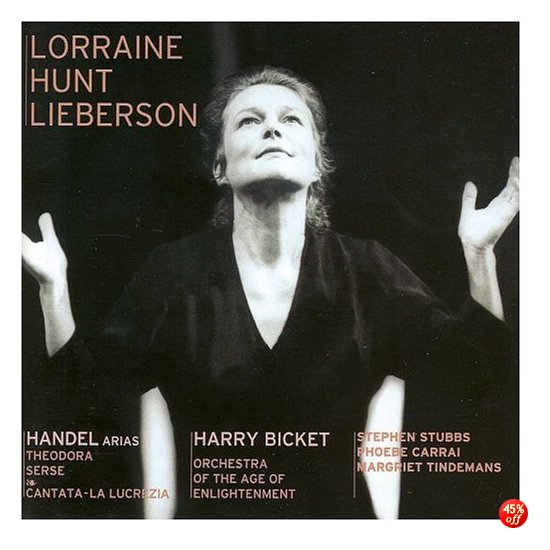
Today when I was teaching, I noticed that months ago I'd penciled in to the top of one of the pages of my student's Schubert sonata "Lorraine Hunt Lieberson -- Handel arias" ...
My heart skipped a beat. She was someone so completely connected to the poetic realm that not a single soul seemed to miss out.
I had wanted my student to be inspired by her. To find a way to be hugely communicative, even when the marking is pp.
Or better,
because the marking is pp.
Monday, April 17, 2006
Pulitzer in mano!
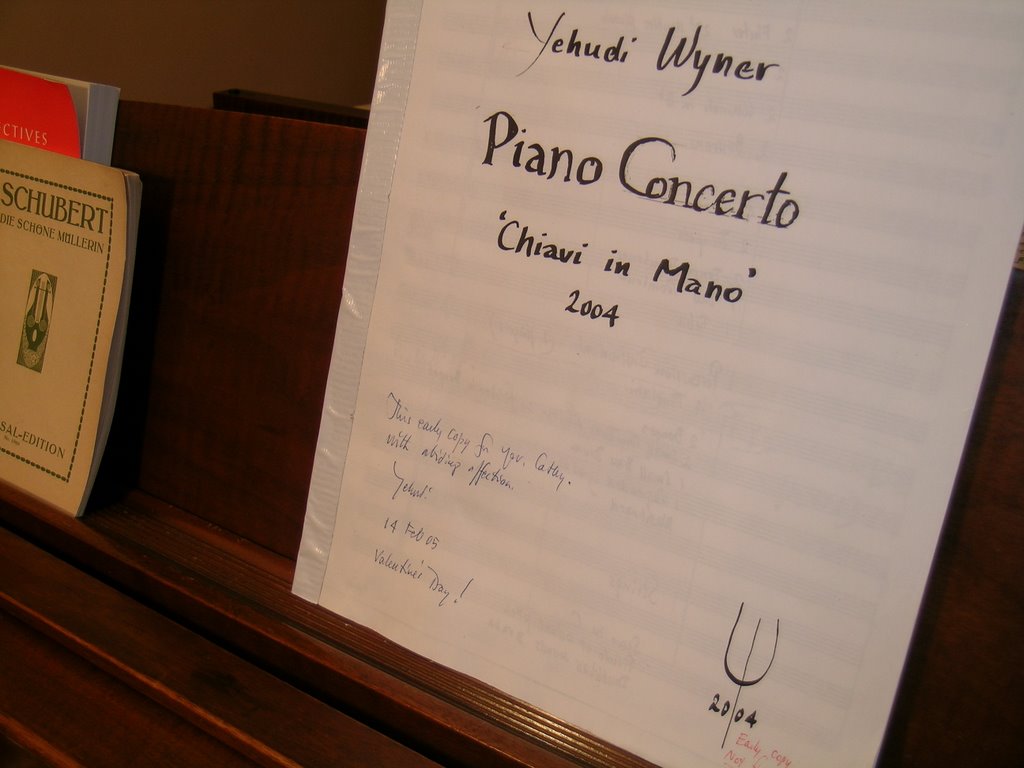
This early manuscript hasn't left my piano since it was given to me by its composer Yehudi Wyner in February 2005. It was just before pianist Robert Levin and the Boston Symphony Orchestra gave the premiere under conductor Robert Spano. I was so deeply touched, and I've lived with the score as an inspiring part of my daily landscape.
Just hours ago, it was announced that Yehudi will be awarded the 2006 Pulitzer Prize for this piece.
And I'm relishing this ecstatic feeling that the world is back to spinning as it should.
The concerto is delicious. It's charged. And it's propulsive and human .. witty, vital and warm. It glistens.
The composer's note from Schirmer:
The idea for a piano concerto for the Boston Symphony was instigated by Robert Levin, the great Mozart scholar and pianist. The idea was evidently embraced by BSO Artistic Administrator Tony Fogg and supported by Music Director James Levine.
Much of the concerto was composed during the summer of 2004 at the American Academy in Rome in a secluded studio hidden within the Academy walls. While much of the composing took place far from home, the concerto comes out as a particularly "American" piece, shot through with vernacular elements. As in many of my compositions, simple, familiar musical ideas are the starting point. A shape, a melodic fragment, a rhythm, a chord, a texture, or a sonority may ignite the appetite for exploration. How such simple insignificant things can be altered, elaborated, extended, and combined becomes the exciting challenge of composition. I also want the finished work to breathe in a natural way, to progress spontaneously, organically, moving toward a transformation of the musical substance in ways unimaginable to me when I began the journey. Transformation is the goal, with the intention of achieving an altered state of perception and exposure that I am otherwise unable to achieve.
"Chiavi in mano" - the title of the piano concerto - is the mantra used by automobile salesmen and realtors in Italy: Buy the house or the car and the keys are yours. But the more pertinent reason for the title is the fact that the piano writing is designed to fall "under the hand" and no matter how difficult it may be, it remains physically comfortable and devoid of stress. In other words: "Keys in hand."
--Yehudi Wyner, December 13, 2004
My infinite heartfelt and admiring thoughts go to this genuine and brilliant man.
There is an interview which I did with Yehudi and Robert about the concerto and much more here
Congratulations, Yehudi!
With much, much love.
Tuesday, April 04, 2006
Taming the lascivious sarabande ...
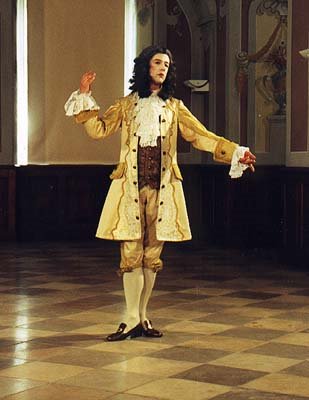
I've recently spent time visiting again with the G Major French Suite of Bach. Even after playing it in concert, the mysteries of its songful Sarabande continue to tickle me and draw me back, back, back to the piano. On certain days it is unearthly -- a perfect, weightless dream. On other days, its shadows and crevices become essential. It gets weighty and human, and I bend it, perhaps, where it shouldn't be bent ...
These different lights seem to change the music every day. It can feel different every time I touch it.
Ah, Bach anguish.
The other day I was lying on my living room floor (I'm not sure why) and there on a very low little bookshelf was Meredith Little and Natalie Jenne's book Dance and the Music of J.S.Bach.
Chapter 7 tracks the "tawdry" history of the Sarabande. From Spanish origins, it arrived in Italy as an exotic and tempestuous dance with fiery variations. Opponents wrote passionately against its lasciviousness.
The French are said to have "tamed" the thing, giving it order and balance. But the two authors spend time considering the teasing passion behind all that balance by citing a recently discovered description written in the 1600's of a solo dancer seducing a crowd with his sarabande:
At first he danced with a totally charming grace, with a serious and circumspect air, with an equal and slow rhythm, and with such a noble, beautiful, free and easy carriage that he had all the majesty of a king, and inspired as much respect as he gave pleasure.
Sometimes he would glide imperceptibly, with no apparent movement of his feet and legs, and seemed to slide rather than step. Sometimes, with the most beautiful timing in the world, he would remain suspended, immobile, and half leaning to the side with one foot in the air; and then, compensating for the rhythmic unit that had gone by, with another more precipitous unit he would almost fly, so rapid was his motion.
Sometimes, for the pleasure of everyone present, he would turn to the right, and sometimes he would turn to the left; and when he reached the very middle of the empty floor, he would pirouette so quickly that the eye could not follow.
Now and then he would let a whole rhythmic unit go by, moving no more than a statue, and then, setting off like an arrow, he would be at the other end of the room before anyone had time to realize that he had departed.
But all this was nothing compared to what was observed when this gallant began to express the emotions of his soul through the motions of his body, and reveal them in his face, his eyes, his steps and all his actions.
Sometimes he would cast languid and passionate glances throughout a slow and languid rhythmic unit; and then, as though weary of being obliging, he would avert his eyes, as if he wished to hide his passion; and, with a more precipitous motion, would snatch away the gift he had tendered.
Now and then he would express anger and spite with an impetuous and turbulent rhythmic unit; and then, evoking a sweeter passion by more moderate motions, he would sigh, swoon, let his eyes wander languidly; and certain sinuous movements of the arms and body, nonchalant, disjointed and passionate, made him appear so admirable and so charming that throughout this enchanting dance he won as many hearts as he attracted spectators.
Sunday, February 19, 2006
"If you were to play me a tune ..."
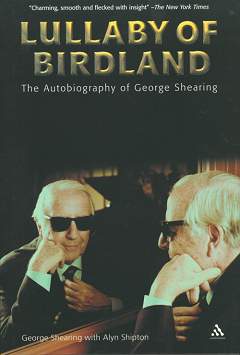
I've rediscovered on our WGBH website a conversation with pianist George Shearing that has me all stirred up. This is the kind of casual and revelatory talking, constantly punctuated by spontaneous playing, that makes me love the radio. I hope you'll take some time to go here.
Then poke around for more astonishments ... Golijov, Machover, Piston, Copland -- and don't miss Lawrence Rosenwald reading some of Emerson's most transcendentally powerful lines and then handing off to members of the Triple Helix Piano Trio, who find similar transcendence in Charles Ives.
Delicious.
Friday, December 16, 2005
Is my disgust showing?
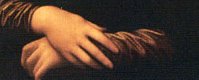
A computer has been used to decipher the enigmatic smile of Leonardo da Vinci's Mona Lisa, concluding that she was mainly happy.

The painting was analysed by a University of Amsterdam computer using "emotion recognition" software.
It concluded that the subject was 83% happy, 9% disgusted, 6% fearful and 2% angry, New Scientist magazine was told.
From the BBC. The story is here.

The painting was analysed by a University of Amsterdam computer using "emotion recognition" software.
It concluded that the subject was 83% happy, 9% disgusted, 6% fearful and 2% angry, New Scientist magazine was told.
From the BBC. The story is here.
Monday, November 21, 2005
Recent shivers ...
Art thrives on metaphysical ideas, which I believe are as old as human consciousness. A great work of art, reflecting the powerful intellect and the compelling imagination of its creator, elicits from us a metaphysical shiver as it confronts us with a vision of ultimate reality.
--Stanislaw Skrowaczewski
Over the past couple of weeks, I've had some very good shivers.
Most profound shiver:
November 13th, Jordan Hall, New England Conservatory of Music in Boston

Pianist Gabriel Chodos played Schubert's A Major Sonata, D.959. I studied with him as a graduate student, and I tried to talk myself into feeling prepared for the heartbreak I knew was coming in the Andantino. When it came, everything changed. Stunned hush. We were all drawn in to Schubert's painful rocking ... the whole building itself fell into that relentless rocking. Something in Schubert exposes the truth about loss. The evaporation of love. Schubert doesn't get easier to take with age. And when this movement is right, it can undo me. And things get worse at that exquisite moment when the sadness is reduced to one single, luminous thread of sound -- the rocking finishes and there we all are, dangling high above God-knows-what realms of the heart, hanging on to one single homeless voice (and following it as if we'd never, ever heard it before)... until the madness sets in. Schubert writes the truth about madness. I wished it would end, and I wished it would never end. This was a metaphysical shiver.
Most astonished shiver:
November 7, Mechanics Hall, Worcester, Massachusetts. The Worcester Music Festival.

Hearing the 29-year-old French violinist Renaud Capuçon. I stood with brilliant sound engineer Antonio Oliart dead center in the first balcony at the back of Mechanics Hall, to listen to some of the rehearsal an hour before the program. Korngold Violin Concerto (as lush as it gets). Dennis Russell Davies, conducting the Bruckner Orchestra Linz. When Capuçon drew his bow, the place virtually blossomed with a sweetness and richness of sound ... we both exhaled audibly. Gorgeous. Renaud plays the violin that Isaac Stern played for fifty years, and he told me that it makes him feel as if he has "different shoulders." This was a good-hearted shiver.
Most enigmatic shiver:
Friday, November 18th, The Regattabar, Cambridge Massachusetts
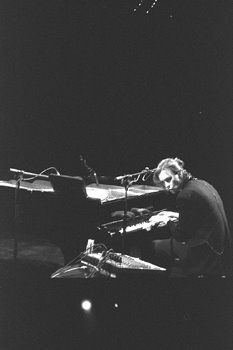
Front row table to witness a force unlike any I've heard before. Patricia Barber reaches into strange and artful territories with her voice. Her pianism is extraordinary. She is uncompromising -- a perfectionist with a nearly compulsive need to speak the truth. She never stops moving. She strikes bizarre open-mouthed poses. Her hands stab at the air, rub themselves with a kind of madness, then stir up a magic on (and in) the piano. She sets songs to the poetry of Verlaine. She is not to be missed. A mysterious and baffling shiver.
Saturday, November 12, 2005
"The wings of one's conception ..."

Back to the 'sphere from God-knows-where ...
smiling about Jeremy Denk's encounter with those who overhear him practicing Berg.
There's healthy blogger-anxiety over the New York Times article conjecturing about the health of Lorraine Hunt Lieberson. Vilaine Fille, Alex Ross and Steve Smith have touched on the tension between musicians and the media.
 I have moved from address to address a number of times, and I carry with me a number of boxes of books. I've neglected so many of them that should I one day fall completely out of sanity, they will, I'm sure of it, plot a brutal and breathless attack on me ... I sometimes think I've heard them whispering about it already.
I'll occasionally, to ease the ache, violate them with random openings (they must hate this).
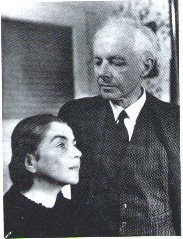
One book which I've dragged along from house to house for decades yields marvels with every violation. Written by Agatha Fassett, it is a poetic account of Béla Bartók's American years -- the last five of his life. The Naked Face of Genius is a 1958 publication of Houghton Mifflin:
These last five years, as they slowly unfolded before me, attained in an unrelenting cycle the roundness of a lifetime, as massive and preordained as a Greek tragedy. And his wife Ditta, linked in the same chain of circumstances, inevitably shared in her own way the anguish of Bartók's destiny.
Bartók remained permanently lonely here, since he was not the kind to transplant well, and every step was made harder -- for although he did not know it, soon after he arrived here the seed of his fatal illness, leukemia, was within him, and wherever he went he was followed by the doom of his tightly numbered years.
She remembes Bartók's description of his first public appearance as a nine-year-old pianist:
"It seems to me that I always played the piano, and always seriously ... that I always dug up fragments of music I considered my own; and it was never anything else but an intensely consuming occupation ...
"What I remember most distinctly from that occasion is the awareness I had of being confined within certain uncomfortable boundaries, and how I tried to console myself with the thought that this was just a temporary condition, an obstacle caused by my limited knowledge, and that it only rested within myself to break through these boundaries into a greater freedom. And the desire to do so filled me with an impatience so unbearable that it was almost physical pain.
"Nothing could speak more eloquently of my innocence at this time than the belief that I could make my boundaries disappear. For only much later comes the discovery that one remains confined, to a lesser or greater degree, forever, and the wings of one's conception are always clipped."
Fassett remembers her walks with Bartók through the Vermont countryside. He would poke at cow dung, digging into it with his walking stick:
"There is life in this dried-up mound of dung," Bartók would say. "There is life feeding on this dead heap." And he would crumble it apart with his cane. "You see," he would say, scrutinizing it intently, "how the worms and bugs are working busily helping themselves to whatever the need, making little tunnels and passages, and then soil enters, bringing with it stray seeds. Soon pale shoots of grass will appear, and life will complete its cycle, teeming within this lump of death. Once in a mound like this I found a tiny shoot of an apple tree growing, springing up with so much confidence -- a long time ago, in Hungary. It could be bearing fruit by now, but more likely its life was crushed out almost as soon as it started, for Nature takes life as abundantly as she gives it."
The author tells story after impossibly poignant story, with genuine, tactile detail:
... Bartók, huddled in his old flannel robe, reminded me of a chestnut vendor bending over his tiny stove. He would be working on his Romanian collection, spread all around the room, and he needed only a glance at these single pages to place each one on the pile where it belonged. Every featherlike sheet added still one more link to the complicated system of classification, where every small variation of rhythmical pattern played a part in revealing relationships between peoples and places.
Perhaps for Bartók these notes, like pressed flowers in an album, still retained traces of their original fragrance, potent enough to draw him back to the land where he first found them and releasing him from the shadows of the room where he sat.
The story of Bartók and Ditta playing with Fritz Reiner and the New York Philharmonic is astonishing. The first performance of the Concerto for Two Pianos and Orchestra is described by the author who, from the audience, sensed that Bartók suddenly somehow broke away from the rest of the musicians onstage ... he was playing something entirely unknown to her, "something that had an immediate and bright existence of its own but still seemed an integral part, inseparable from the rest."
She remembers the conductor's reaction after the performance:
"What on earth came over you, Béla?" Reiner said in a voice that was cold, but somehow compassionate too. "How could you endanger everything, risking disaster for a momentary whim? Didn't you realize what an impossible task it was, trying to follow you through your wanderings? For all of us, not to mention Ditta!"
Bartók looked up at Reiner and did not say anything, and seemed to remain detached and undisturbed.
He held his brooding silence in the taxi on the way to Riverdale, and we were already going up the hill when he sat up straight and turned to Ditta.
"The tympanist," he said, "the tympanist is the one who started everything. He played a wrong note, suddenly giving me an idea that I had to try out, and follow through all the way, right then. I could not help it -- there was nothing else for me to do."
I'll either hyperventilate, or read the whole thing ... Look, I've gone and typed a good chunk of it already ...
Friday, October 14, 2005
Piano Trips
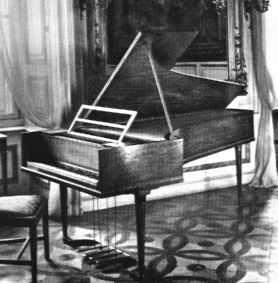 Bart Collins offers the usual tour of fascinating piano destinations on his Well-Tempered Blog, including a trip to Maison Erard, and a look at this 1803 piano of Beethoven's, thanks to a link to Stephen Birkett's web page. There you'll find the bright, near-giddy sound of an 1822 Erard. And Bart gets you to the Chopin Competition, mp3 breast implants, and Beethoven's newly unearthed four-hand manuscript of the Grosse Fuge ...
It often happens that I'll be stunned by music while doing the broadcaster's dance (taking transmitter readings, signing logs, searching for that pithy segue)... Today pianist Randall Hodgkinson's resonant and genuine way with the first three Moments Musicaux of Schubert drew me to a place far, far, far from the relentless clock (the one that wags its merciless finger at every soul who sits in front of a microphone) ...
The thing to do when such a sweet, inspired moment arrives is to crank up the studio speakers and get the ON-AIR light glowing at every door ... so no one dares to interrupt.

Tuesday, October 11, 2005
The Good Doctor

"Any musical value heard [in the cylinder recording] can be charitably described as the product of a pathological imagination."
This is musicologist Gregor Benko's remark about the nearly impenetrable noise on a very famous recording of Johannes Brahms playing the piano in 1889 at the home of Dr. Richard Fellinger in Vienna. Thomas Edison was sending emissaries to record the voices of famous people for use as advertisements. This wax cylinder was made for Edison by Theo Wangemann. Scholars have strained to analyze the rhythmic nuances of the recording's too-few measures of the 1879 arrangement of the first Hungarian Dance, and part of a paraphrase of Strauss's "Libelle". And many a lover of Brahms has gleefully imitated the introduction at the start of the cylinder:
"I am Dr. Brahms ... Johannes Brahms."
What a surprise! A strangely startling voice from the great, autumnal philosopher himself ...
But, perhaps not.
"The spoken text at the start of the cylinder recording has been wrongly attributed as belonging to Brahms. Numerous writers, scholars and amateurs alike, have presumed that Brahms introduces himself with the words "I am Doctor Brahms, Johannes Brahms". However a number of factors raise serious doubts as to who is speaking. The only mention of the recording by someone who was present (in the published memoires of Fellinger's son) states that Brahms was introduced. Considering the time between the announcement and the start of the music it seems improbable that the same person could segue from speech to playing so quickly particularly given the technological limitations.
The denoised excerpts reveals enough of the speech to suggest that the speaker (probably Wangemann) introduces Brahms as follows:
"...Dezember Achtzehnhundertachtundneunzig. Haus von Herrn Doktor Fellinger, bei mir ist Doktor Brahms, Johannes Brahms".
("...December Eighteen Hundred Eighty Nine. House of Mr. Fellinger, with me is Doctor Brahms, Johannes Brahms.")
Read about the playing and the talking, and the man who has painstakingly denoised the cylinder here.
Saturday, September 24, 2005
Dreamhouse
Over the past three years, he has hosted a small series of concerts at his home, which have featured acquaintances. "I have a lot of friends who are artists and who deserve to be heard, and I wanted to showcase them here," he says. His most recent performance, in April, featured a concert pianist-friend from Japan. The show, which drew around 65 people, began with the pianos on the first floor, with the pianist and audience working their way up to the second in order to match the pieces to the pianos best-suited for them.
--excerpted from The Boston Globe
Don't miss Wqan Ang's Boston Globe photos of a Boston psychologist's home, filled to overflowing with pianos.
P.S. I know he works with children ... but if he were my psychologist, I'd be cured.
--excerpted from The Boston Globe
Don't miss Wqan Ang's Boston Globe photos of a Boston psychologist's home, filled to overflowing with pianos.
P.S. I know he works with children ... but if he were my psychologist, I'd be cured.
Tuesday, September 20, 2005
A few chords short ...

I felt so behind in my preparation, anxiety set in with its cousin, insomnia. I began pathological bouts of list-making — the Chopin group, the Schumann group, the 21st-century music, the recital program, the lecture-recital. In the middle of telephone chats, I was apt to recite my columns to the vague discomfort of friends. For me it had become a ritual for the calming of runaway nerves.
So, naturally, just as I’m a few chords short of entering Bellevue for observation, the telephone rings and a conductor speaks. As any pianist knows, a conductor’s call has a special ring. The conversation: Do I know the Beethoven Third, can I play it in a month, we’ll speak again on his return from Europe, so yes, it’s a go. A few moments of pure elation. The anticipation of a concerto with orchestra is a sweet one. It gets the inner metronome beating faster. The Beethoven C minor concerto with a good chamber orchestra! Then panic. On top of everything else, I now need to reconnect with a great work and bring it to life as swiftly as possible.
Part of a diary entry and one of many articles that pianist Beth Levin has contributed to the online music review La Folia. In Beth's playing, her honesty, tenderness and fierce tehnique can stop your breathing.
 She writes: “I live with my family in Brooklyn. I very much wanted children and was eager for the challenge of balancing a musical life with a home life. One of my favorite tasks is to pop a lasagna into the oven while doing some intense practicing, thereby fulfilling two roles at once — mother and musician.”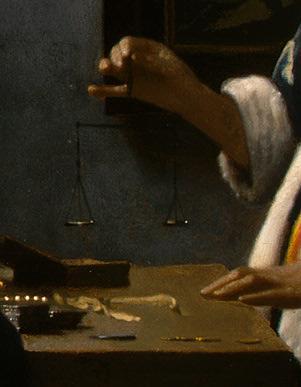
Saturday, September 17, 2005
There's No Place ...
Pliable offers more paths to important performances and astonishing productions ...
And while I was considering Edinburgh last night, McCoy Tyner was coaxing his Steinway into an ecstatic jangle in my living room ... a state of confident grace there on my television, raising money for New Orleans.
Danny Glover arrived to speak eloquently on Katrina:
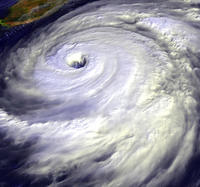
"She has revealed a poverty of imagination ..."
Jessica Duchen writes a post about the marvels and the thrill of the Eternal City
and she imagines that Dorothy must have actually said
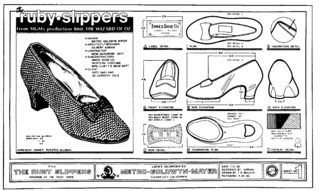
"There's no place like Rome."
It brought on a brutally tender memory of Judy Garland. My father loved her deeply as a friend, and as her agent near the end of her life. They had marvelous, hilarious times together. I was about nine years old when he brought me to New Jersey to see her perform (she collapsed on stage that night). Earlier, in her hotel suite, I remember playing for her on an upright piano. It was Ellfenreich's little "Spinning Song", a piece that has entered the lives of so many little pianists. I sat down next to her when I was done, and she took my face into her hands with a passionate, surprising suddenness, and kissed me on the mouth. When we went out to the Boardwalk, passing through crowds of admirers, I remember her telling people that I was her daughter. Now that I'm older, I'm able to imagine the loneliness that must have shadowed her all the time. Except from the stage. And that must have been where she found the life-saving intimacy that we all need.
Looking into the living room at McCoy Tyner, I thought I saw it there, too.
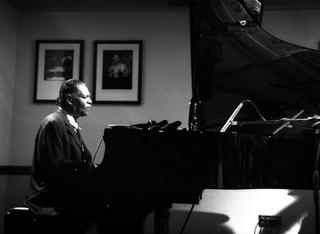
And while I was considering Edinburgh last night, McCoy Tyner was coaxing his Steinway into an ecstatic jangle in my living room ... a state of confident grace there on my television, raising money for New Orleans.
Danny Glover arrived to speak eloquently on Katrina:

"She has revealed a poverty of imagination ..."
Jessica Duchen writes a post about the marvels and the thrill of the Eternal City
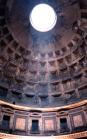
and she imagines that Dorothy must have actually said

"There's no place like Rome."
It brought on a brutally tender memory of Judy Garland.
 My father loved her deeply as a friend, and as her agent near the end of her life. They had marvelous, hilarious times together. I was about nine years old when he brought me to New Jersey to see her perform (she collapsed on stage that night). Earlier, in her hotel suite, I remember playing for her on an upright piano. It was Ellfenreich's little "Spinning Song", a piece that has entered the lives of so many little pianists. I sat down next to her when I was done, and she took my face into her hands with a passionate, surprising suddenness, and kissed me on the mouth. When we went out to the Boardwalk, passing through crowds of admirers, I remember her telling people that I was her daughter. Now that I'm older, I'm able to imagine the loneliness that must have shadowed her all the time. Except from the stage. And that must have been where she found the life-saving intimacy that we all need.
Looking into the living room at McCoy Tyner, I thought I saw it there, too.

Sunday, September 04, 2005
Piano flashbacking

Bart Collins in a recent post features an article that touches on the strange and indescribable connections between music-making and memory, and it's prompted me to think again about a recurring condition of mine. It's a strange, occasionally eery and consistent flashbacking (best verb I can think of) that happens nearly every time I practice the piano. These are astonishing, out-of-the-blue, instant transportations to forgotten moments ... (as a 9-year-old walking past a swing ... as a 28-year-old sitting a certain way in a certain house ...) Mundane and tiny they often are, yet they are perfect recollections. Little virtual realities that arrive with an absolute suddenness. Absolutely unpredictable. Always when I'm involved in playing. And it always feels as though I'm reliving the moment for the first time.
This happens so regularly that I've just folded it into the library of the everyday. But over the years I have tried to think scientifically about the cause, as if I were trying to narrow down the triggers of an allergy, or a headache. I've imagined that it might be certain measures of certain music (can't find any evidence of that) ... or a certain exactly re-struck piano-playing pose that my muscles somehow remember (but there are such an infinite number of them) ...
In the end I've left it all in the unsolved mystery files, but I really think that it has got to have something to do with the place that music naturally occupies in our mind's blueprints. Bart quotes Paul Robertson, the founder of the Medici Quartet: "Music is the underlying structure of communication.”
It's a big thing to say.
But it strikes a chord (as they say).
And helps to emphasize the poignancy of a saying whose source I'm still trying to find ...
We danced before we walked and we sang before we talked.
(I'd love some help on that one.)
I did an interview once with Mikko Nissinen, the Director of the Boston Ballet. He told me that he immediately knows when he's watching a good dancer because it seems as though the dancer is the source of the music.
That thought has never left me.
In any case, I've long wondered whether any other pianists go flashbacking like me ....
Thursday, September 01, 2005
MoveOn.org has begun an emergency online national housing drive to help victims of Katrina who desperately need shelter.
And the Red Cross has made it simple to donate.
Every moment counts.
And the Red Cross has made it simple to donate.
Every moment counts.
Subscribe to:
Posts (Atom)